Current Residence
Wasilla
Age
73
Current and previous occupations
38 years as an Alaskan educator: teacher and principal at Palmer High School; superintendent of Mat-Su Schools; term leadership faculty and interim dean, UAA College of Education
See Chesbro’s financial disclosure report here.
Educational background
Bachelor’s degree in English education from Syracuse University
Master’s degree in reading education at SUNY Albany
Principal and superintendent credentials from UAA
Voting Record
Candidate has not held public office.
Campaign Website
www.chesbroforalaska.com
Reasons for Running
Why are you running for the U.S. Senate?
As a longtime educator, I find myself increasingly concerned for our children and young people. At a time in their lives when they should be feeling hopeful and optimistic about the opportunities that lie ahead, they see division, disrespect and intolerance in the language of local and national leaders. They see efforts to take away rights that have been fought for and respected for many years, including a woman’s right to choose, and they wonder which rights will be next. They see thwarted efforts to address climate changes that endanger our earth. They see ongoing gun violence that takes young lives through suicide and homicide. I say, the elected leaders of our country set the tone for this nation. They either model the behavior we want for our children, or foster cynicism and hopelessness. I am running to address these and the many other issues that threaten our children’s future. I am running to help set a positive tone.
Working Together
How would you work with people who have different political viewpoints? Provide examples of how you have successfully done this in the past.
Leaders know that it is vital to hear and respect the viewpoints of those with whom you may initially disagree. As a principal and superintendent, I certainly found many moments in which my principles and perspectives did not align with those with whom I worked or led. However, I learned long ago that listening is the best tool a leader can use. Similarly, listening, questioning and finding common ground are keys to working with people whose political perspectives differ from mine. I currently serve on the Mat-Su Borough Planning Commission. The work of the commission often reveals different points of view about land use, whether it be a permit to mine gravel or a permit to cultivate marijuana. I listen carefully and make my decision based on the multiple sources of information that are presented. I believe we are all trying to achieve similar ends for our nation. We often differ in our approach to solving those solutions.
Salmon
What steps would you take to help restore depleted salmon populations and ensure salmon runs remain strong in Alaska?
As with most issues, depletion of salmon populations has many complex causes. One of those causes, of course, is climate change. In fact, the Southeast Conference Seafood and Maritime Industry Committee listed climate/ocean change as their top weakness in the seafood industry and listed global warming, ocean change and ocean acidification as the top threat to their industry. In my limited understanding, it seems that the different species require different food sources, different maturation times and different water temperatures. This does not seem to be a one-size-fits-all situation. More mechanical, and perhaps easily solved issues, relate to excessive bycatch which is discarded by fishing vessels. This is much fish that could be eaten or used to sustain the species. It seems that more observers could travel on fishing vessels to measure bycatch. Also, the unintended harvest could be used against the quota for the vessel and sold/distributed for use by those threatened by food insecurity.
(Listen to the Kodiak Fishery Debate between Murkowski and Chesbro for more detailed discussions of fisheries issues.)
Abortion Access
Now that Roe v. Wade has been overturned, what, if any, legal changes would you propose in Congress with regard to access to abortion?
Medical privacy, including but not limited to abortion access, should be protected by federal law. Even Roe v. Wade did not provide the kinds of protections that a medical privacy act could assure. We have seen states consistently diminish reproductive rights since the Roe v. Wade decision. Hence, any new law should guarantee reproductive freedom. As we have seen in the recent decision of Oberlin College’s health care provider to deny contraception services to students, the far-reaching effects of the overturning of the decades-old right to abortion access can be unforeseen and unexpected. Health care is a human right. Reproductive decisions should be made by the woman with the advice of her medical professional.
Gun Violence
What measures, if any, should we take on a federal level to reduce levels of gun violence?
Gun violence is the leading cause of death among young people. These deaths may be by accident, homicide or, in the majority of cases, suicide. Availability of firearms makes snap decisions easy. My friend’s brother had been depressed and his family moved their firearms to what they thought would be a safer location. Unfortunately, he found a weapon and committed suicide. Safe gun storage is essential to preventing these types of tragedies. Trigger locks should be applied to weapons; ammunition should be stored separately from guns; guns should be locked in secure storage, with limited access. I spoke with a person who had visited schools to present gun safety education to sixth grade students. Such education and more emphasis on safe gun storage could help to save lives. Gun manufacturers could include trigger locks with every weapon as well as safety suggestions. I believe it is usually difficult to predict who will commit violent crime, but we can perhaps curb some of the tragic rash decisions that cause death.
Climate Change
What will you do as a U.S. senator to address climate change?
President Biden has working to help the U.S. address climate change. This, too, is a complex issue. Effective measures will require all of us to identify our own contribution to the problem and make some decisions about the personal choices and even sacrifices that are necessary to work toward slowing down the destruction. I admit to heating my house and cooking with natural gas. I admit to driving a gasoline-powered car. I admit to enjoying travel by air. Every decision made by the Senate should take climate change into account. How can we urge Americans to consider this as a similar situation to World War II, where everyone contributed to the effort? A U.S. senator’s voice carries power and can influence her constituents. Climate change must top our agenda. Our children’s future is in jeopardy if we don’t.
Campaign Finance
What, if anything, needs to change about how candidates and elections are funded?
Though I do not think money is the only aspect of an election, I think having the resources to inform voters of a candidate’s stand on issues is important. My team and I are running what I call a fiscally conservative campaign. All of our money has come from individuals, mostly in Alaska, but not entirely. I am proud of the many people who have helped. I think elections will remain lopsided until we get a handle on the unreasonable amounts of money spent to persuade voters. The wealthy should not control our legislatures. I do not believe corporations are people and I regret that corporate influence remains so strong in our system. I worry that the enormous funds expended might be better used to feed children, or house the unhoused, or ensure medical care for all.
Inflation
How will you work to help ease the impacts of inflation on Alaskans?
Alaska is very reliant on transportation for our many needs. Emphasizing self-reliant food sources is vital. Local farmers, fishermen and food processors can stabilize food security. We can begin to build small industry to supply our needs rather than rely on those outside our state. Until we find better ways to transport our necessary products to and from Alaska, we will be at a disadvantage. I will search out ways to improve supply chain that will benefit instead of tax Alaska.
Health Care Costs
What would you do to bring down the costs of health care, including the high cost of prescription medications, and how would you improve health care access?
The Inflation Reduction Act will target the cost of prescription drugs for seniors. This is vital for seniors’ health and well-being. Unfortunately, this relief is limited to Medicare at this time. We should be looking carefully at the results of this legislation, adjust it as necessary and move it to the wider prescription drug market.
Inter-governmental Relationships with Tribes
How will you facilitate inter-governmental relationships with Alaska’s 229 sovereign tribes?
Trust and respect are key to strong inter-governmental relationships. I will listen first, then work with tribes to act in their interests and the interests of the state. If not already in place, I will help to develop standing committees to discuss and act on important issues to our tribes.
Other Issues
What other important issue would you like to discuss?
Education and workforce development are two vital components of the future lives of Alaskans. We must work to strengthen P-12 education, expand vocational and technical training opportunities, and ensure that our universities are well funded. Well-funded universities attract quality faculty who in turn attract research which helps us to understand our world and its people. We live in a world where teachers are demonized and education financing is precarious. The power of education fuels our future. It is worth our support and our respect.
Campaign Contributions
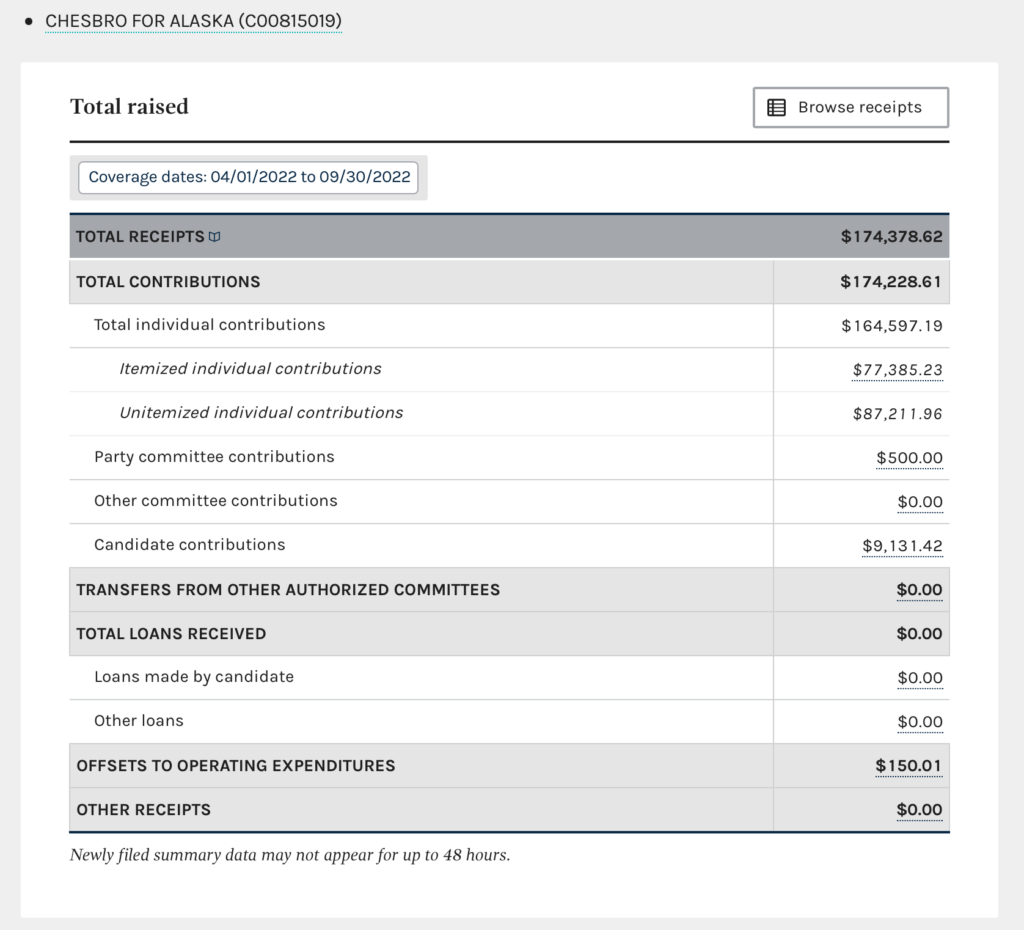
Chesbro’s contributions have more than tripled since the last report on July 27. Her total contributions are $174,228.
Understanding FEC filings: Contributions only need to be itemized if they are larger than $200 or if the combined contributions from one person for that election year are more than $200. Because 40 percent of Chesbro’s donations aren’t itemized, an analysis of where donors are from or how many she has wouldn’t be accurate. Her largest donor is herself with $9,131. Only five other people donated $1,000 or more.
No organizations have spent money as independent expenditures on her behalf.