Current Residence
Anchorage
Age
43
Current and previous occupations
Wife, mother of five, candidate for the U.S. Senate
After serving as Alaska’s commissioner of Administration from January 2019 to March 2021, Kelly Tshibaka announced her campaign for the United States Senate. She previously served as chief data officer for the Inspector General of the U.S. Postal Service under Presidents Trump and Obama. She also was acting inspector general for the Federal Trade Commission, counsel to the Inspector General in the Office of the Director of National Intelligence, and served in the Office of Inspector General of the Department of Justice.
See Tshibaka’s financial disclosure report here.
Educational background
Steller Secondary School, Anchorage (1995), Texas A&M (bachelor’s degree, 1999), Harvard Law School (J.D., 2002)
Voting Record
Candidate has not previously held public office.
Campaign Website

Reasons for Running
Why are you running for the U.S. Senate?
I was born and raised in Alaska and my parents were homeless for a while. They fought their way into the working class — my dad worked as a union electrician and my mom worked at the startup of Prudhoe Bay. I was the first in my family to pursue a college degree, and then I went on to law school, where I met my husband, Niki, the son of an African immigrant. Together, we have five children.
I’m running for the Senate because the people of Alaska stood up for me and gave me opportunities. Now I want to stand up for the people of Alaska.
Our resource industries and economy have been destroyed by Joe Biden and his radical cabinet members — nearly all of whom were confirmed by our 21-year Senate incumbent.
I’ve spent my career holding government insiders accountable. I will fight to make government work for the people of Alaska, instead of working against us. I am from Alaska and for Alaska. When I represent Alaska in the Senate, I will never forget the Alaskans who sent me there.
Working Together
How would you work with people who have different political viewpoints? Provide examples of how you have successfully done this in the past.
I have been effective at solving problems in government and maintaining my integrity simply by knowing the difference between my principles and my preferences. I am willing to compromise on preferences to get things done, but if you compromise on principles, you cannot be trusted.
For example, I drafted legislation to create the Intelligence Community Inspector General. It took me five years to get it through the approval of 17 agencies, the White House, both houses of Congress and both parties. I had to compromise on a lot of preferences along the way, but I did not compromise on the fundamental principles behind the legislation.
I look forward to engaging in wide-ranging discussions of policy with any member of the Senate, and to finding common ground wherever possible. But I will not compromise on what is right for Alaska.
Salmon
What steps would you take to help restore depleted salmon populations and ensure salmon runs remain strong in Alaska?
Our salmon are a valuable and sacred resource that must be available to all Alaskans, with a prioritization on subsistence first. I strongly support increased Coast Guard aircraft, drones, cutters and resources in Alaska to enforce our EEZ. I also support funding for research not yet conducted to understand migration patterns.
I support exploring creating a new fisheries management council to manage Alaska waters. The NPFMC is the largest of the eight fisheries management councils. A new fisheries management council for Alaskan waters would improve the odds that Alaska gets its fair share of the fisheries harvest. I also will work to address the issue of bycatch overage in a meaningful and fair way. I support examining changes needed to statutes, regulations and the observer program, such as consistent electronic observation on all commercial vessels. For the sake of our fish, our ocean habitat, our fishermen, our families, our communities and our future, bycatch overages must be addressed.
Abortion Access
Now that Roe v. Wade has been overturned, what, if any, legal changes would you propose in Congress with regard to access to abortion?
The Supreme Court has placed decisions on abortion laws in the hands of the states, which is consistent with the Constitution’s 10th Amendment. Like me, many Alaskans are pro-life and oppose the existing state law, which permits late-term abortion on demand, even when a baby is full-term. In contrast, the incumbent has voted to allow late-term, partial birth and taxpayer-funded abortions.
(Editor’s note: Murkowski has voted against partial birth abortions and in favor of prohibiting using federal funds for abortions.)
I support expanding access to birth control without a prescription, so adult women can get it both over-the-counter and through the mail. I do not support restrictions on access to birth control, which millions of women — myself included — have taken. Birth control and abortion pills are not the same thing. Also, I believe Congress should provide more funding to our local health care clinics here in Alaska that provide non-abortive health care services to women.
Gun Violence
What measures, if any, should we take on a federal level to reduce levels of gun violence?
As a mom of five school-aged children, I know that we must provide safe schools for our kids. I support greater funding directed towards mental health resources, which is at the root of many of the gun violence episodes we have seen recently. I also would support strengthening and improving the security in our nation’s schools.
We also must protect law-abiding citizens’ rights. Alaskans rely heavily on our Second Amendment rights, and I will oppose any effort to infringe on those rights. The incumbent voted for Biden’s red flag laws, which will result in some Alaskans losing their guns without due process of law. As a result, the NRA downgraded her rating. In contrast, I have the NRA’s highest rating and I’ve been endorsed by the Gun Owners of America.
(Editor’s note: Research shows that people who experience mental health challenges are more likely to be victims of gun violence or to die by suicide than to perpetrate violence on others.)
Climate Change
What will you do as a U.S. senator to address climate change?
We all agree on wanting clean air and water. But even John Kerry has said it would have no impact globally if the U.S. cut its carbon emissions completely to zero. Instead of pushing big government climate change policies, we need to acknowledge that in Alaska we produce energy cleaner and more efficiently than other less environmentally responsible nations. President Biden is asking those less efficient countries to increase their own output while he shuts down our energy production.
I will advocate to prohibit pre-emptive and retroactive vetoes under the CWA, properly define “waters of the U.S.” under the CWA, and reduce taxes and regulatory barriers so we can invest in energy innovation and environmental conservation like the Impact Mitigation Grant program. Reducing energy-killing regulations and facilitating technological innovations in oil and gas production will enable us to continue improving our approaches to resource development and environmental protection.
Campaign Finance
What, if anything, needs to change about how candidates and elections are funded?
At the State Fair this summer, the greatest concern Alaskans shared with me was the disturbing news, revealed in undercover videos, that Sen. Murkowski’s political team used dark money to promote Ballot Measure 2, deceiving Alaskans that they would “get dark money out of Alaska” when it actually brought in ranked choice voting for the purpose of keeping Murkowski in office. In fact, Murkowski’s campaign is mostly funded by dark money.
(Editor’s note: Murkowski disputes these claims.)
In light of how our election process has been re-engineered, I would support legislation to improve transparency, reduce the threat of corruption and make the flow of campaign money more transparent to the public. I also support eliminating the arbitrary contribution limits that encourage donors to circumvent campaign finance laws. Such legislation not only would respect donors’ First Amendment rights, but also would reinforce the sovereignty of the people over elected officials and decrease the threat that donations are given in exchange for votes in Congress.
Inflation
How will you work to help ease the impacts of inflation on Alaskans?
The federal government must stop runaway spending, which pumps too much money into the economy too quickly, devaluing the dollar and driving prices for goods and services higher. We must recommit to increasing the domestic production of energy and unleash Alaska’s energy industries to produce more. We must cut government costs and reduce taxes. Finally, we must reduce excessive regulation of businesses and entrepreneurs so they can help grow our economy.
Health Care Costs
What would you do to bring down the costs of health care, including the high cost of prescription medications, and how would you improve health care access?
Sen. Murkowski was the tie-breaking vote to keep Obamacare, which has increased insurance costs and limited choice because it depends on a centralized, top-down government-led approach. Instead, I support moving the resources and regulatory control to the states, guaranteeing protections for low-income individuals and those with preexisting conditions, and giving individuals more affordable health plan options.
When I was commissioner of Administration, I ran the health care plan for the state of Alaska. We made changes like this and saved tens of millions, increased choices for our members and cut costs for the plan.
I also support allowing lower-cost medications to be safely imported and bringing generic medicines to market quicker. I will support giving tax credits, not just deductions, to physicians who provide services to low-income patients. Medicare savings should not be used to cover debt in Obamacare, but reinvested in Medicare to lower costs for beneficiaries.
Inter-governmental Relationships with Tribes
How will you facilitate inter-governmental relationships with Alaska’s 229 sovereign tribes?
I believe it’s possible to forge a stronger partnership for Alaska’s economic sustainability between tribes, village and regional corporations, and the state and federal government now that Alaska has officially acknowledged tribal recognition.
Over the last decade, the appropriations process has changed, and our senator has not brought home earmarked money for projects like Ted Stevens did. Instead, funds are given to the executive branch, and we have to apply and compete for them. It does little good to get funds appropriated if they never get to actual Alaskans. As senator, I will add a grant writer and contract expert to the Senate staff that Alaskans can use to help get access to funds. This will greatly help our tribes get more funding that is available but hasn’t been accessible.
I also support tax incentives for investing in village corporations and tribal entrepreneurial efforts, and I will advocate to reduce regulations for developing resources on Alaska Native land. As senator, I would practice consultation with the various Alaska tribal consortiums myself, rather than sending staff, and ensure federal agency consultations are occurring as required.
Other Issues
What other important issue would you like to discuss?
Currently, Lisa Murkowski’s seniority is being used to push through Biden’s red flag laws, protections for late-term abortions and radical nominees who are shutting down our resource industries, killing our jobs and crushing our families with inflation. The incumbent says she’s bipartisan, but she obstructed the last administration, hurting Alaska.
We need a senator who will fight for Alaska, not for Joe Biden. I have a long career of exposing waste and abuse, returning billions to taxpayers and passing bipartisan legislation under Obama, Bush, Trump and Gov. Dunleavy. I’ve been endorsed by a Democratic former candidate in this race, Edgar Blatchford, and my rural outreach efforts are led by Alaska Native leader Paulette Schuerch, a non-Republican, who ran Murkowski’s write-in campaign in 2010.
Sen. Sullivan recently said: Do you stand with the American people, the workers, the families who are suffering? Or do you stand with Joe Biden and his radical environmental allies?
That’s the decision before Alaska. Do we want a senator who stands with Alaska, or the senator who stands with Joe Biden? It’s time we have leadership that won’t be bullied or controlled by D.C. insiders. It’s time for a change.
Climate Change Causes
Yes or no, do you think climate change is affected by human activities?
Yes, and we all want clean air and water. However, even John Kerry has said it would have no impact globally if the U.S. cut its carbon emissions to zero. Instead of pushing big government climate change policies that crush resource industries and Alaskan families, we could prohibit pre-emptive and retroactive vetoes under the CWA, properly define “Waters of the United States” in the CWA, and reduce taxes and regulations so we can invest in energy innovation and environmental conservation efforts.
Election Integrity
Yes or no, do you believe Joe Biden won the presidential election in 2020?
Joe Biden is president, but there are still unresolved questions about what happened in the 2020 election. We don’t know the impact of certain things, like the Pennsylvania court deciding its vote-by-mail law was unconstitutional, the Wisconsin court deciding its ballot drop boxes were illegal, the Arizona audit concluding its election never should have been certified, or the $300 million Mark Zuckerberg spent to take over local election offices in Democrat precincts.
(Editor’s note: The Arizona audit did not find evidence of voter fraud, and the millions of dollars that Mark Zuckerberg donated went to nonprofits that distributed grants to state and local governments, to help them conduct the 2020 elections during the first year of the pandemic.)
Ranked Choice Voting
Yes or no, do you support maintaining open primaries and ranked choice voting in Alaska?
No. It’s been exposed that Murkowski’s political team colluded, using dark money funding, to deceive Alaskans that Ballot Measure 2 (ranked choice) would get dark money out of Alaska. But it actually brought in ranked choice in an effort to guarantee her re-election, and Murkowski’s campaign is still nearly entirely funded by Lower 48 dark money. It’s a desecration of democracy to manipulate state law in order to try to ensure your own re-election. Alaskans deserve a fair system.
(Editor’s note: Murkowski disputes these claims.)
Constitutional Convention
Yes or no, do you support a constitutional convention for Alaska?
Yes, I support people’s rights, and Alaskans have a right to vote on whether they want a constitutional convention. I far prefer we go through the complex process of selecting delegates and submitting proposed constitutional changes to a vote of the people than having legislators and unelected judges re-write the constitution on a whim, like how Sen. Murkowski functionally re-wrote the Second Amendment when she voted for Biden’s extreme gun control and red flag laws.
Campaign Contributions
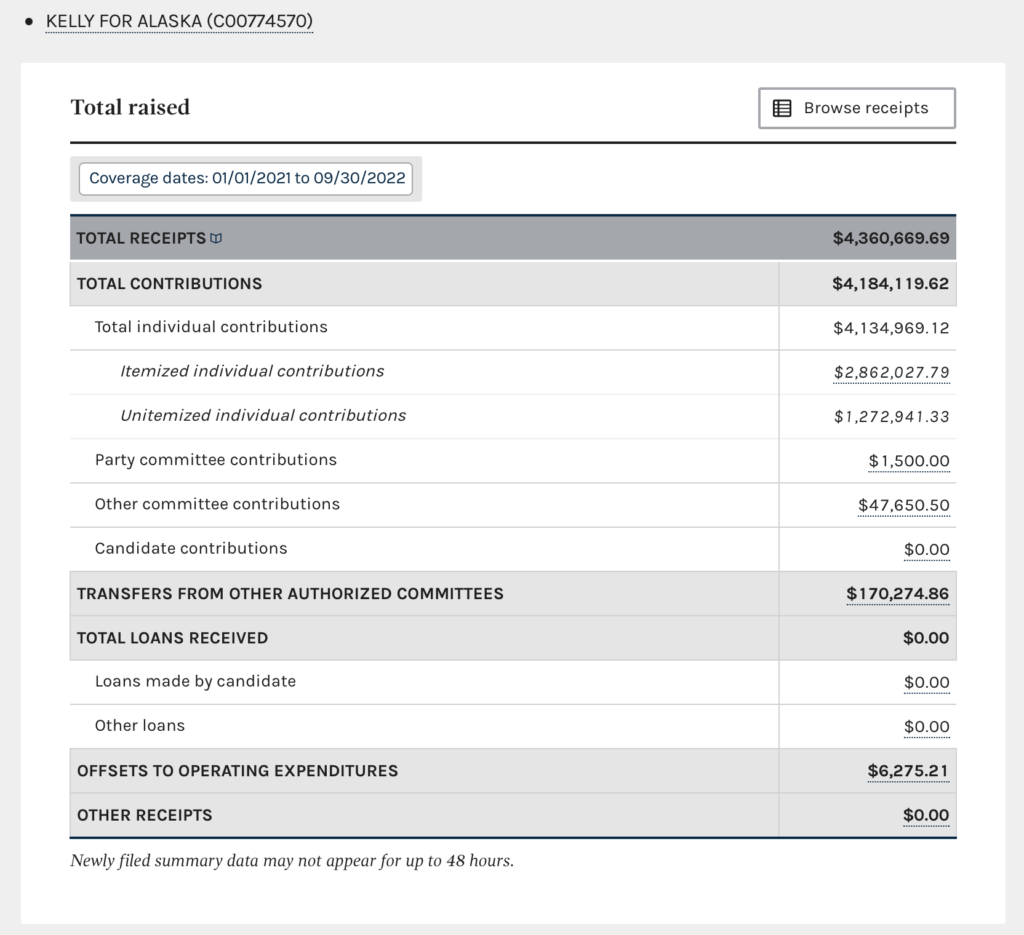
This only covers contributions through September 30, 2022. Tshibaka has raised just over $928,000 since her last report on July 27, and almost all are from individual contributions.
Understanding FEC filings: Contributions only need to be itemized if they are larger than $200 or if the combined contributions from one person for that election year are more than $200. Because about $1.2 million of Tshibaka’s contributions are not itemized, an analysis of where donors are from or how many she has wouldn’t be accurate. Over half of her donations came through WinRed, an online fundraising platform for Republican candidates and conservative groups. Her largest individual donors were Dana and David Cruz of Cruz Construction in Palmer who gave $23,200 combined. Glenn Morris with MM Industries of Chattanooga, Tennessee gave $11,600.
Committee contributions come from groups, like PACs. Tshibaka received $93,247 through Alaska First Fund, a PAC that supports both Tshibaka and House candidate Sarah Palin. Her campaign received an additional $61,865 from the Trump-Graham Majority Fund, which raises money for Tshibaka, Sen. Lindsey Graham of South Carolina, and Trump’s Save America PAC.
Independent Expenditures are things like ad buys or mailers sent out by organizations that are not associated with the campaigns and are forbidden by law from working with campaigns. GOA Victory Fund, which supports pro-gun candidates, spent $23,442 in support of Tshibaka.