Current Residence
Chugiak
Age
44
Current and previous occupations
Founder and executive chairman, Farshore Partners
Founder and managing partner, Dashfire
Alaska Policy Forum, board president (2018-2021)
MTA, board director (2016-2022)
MTA Foundation, board president (2017-2021)
Ford Motor Company, Information Technology Leadership Program (2002-2004)
Sensormatic, investor relations specialist (1999-2000)
See Begich’s financial disclosure report here.
Educational Background
Baylor University, Bachelor of Business Administration, major: entrepreneurship
Indiana University, Master of Business Administration, concentrations: Information Technology and Decision Sciences
Endorsements
Associated Builders and Contractors, Alaska Chapter
Alaska Outdoor Council
Americans for Prosperity Action
HOTL PAC
FreedomWorks
Find other endorsements here.
Voting Record
Candidate has not served in public office.
Campaign Website

Reasons for Running
Why are you running for the U.S. House of Representatives?
If we are going to successfully represent Alaska’s role in our nation to the rest of Congress, it will require someone to make what I call the “business case for Alaska.” I support resource development across the board, and I will never compromise on the freedoms guaranteed to each of us under the U.S. Constitution. I’m running for Congress to bring new energy, new perspectives and new solutions to the job. I will work hard to provide the leadership and representation the people of Alaska deserve.
Working together
How would you work with people who have different political viewpoints? Provide examples of how you have successfully done this in the past.
I want to be a congressman for all Alaskans. In a divided Congress, I believe it is critical that our next congressman have the ability to work with others to advance legislation that is beneficial for Alaska and our nation. We cannot afford to elect representatives who would seek opportunities to intentionally polarize our national discourse or who offer simple, empty rhetoric. As an original co-chair for the 2020 OneAlaska Campaign, I was part of a broad-based coalition of Alaskan leaders across the political spectrum who recognized the danger of punitive oil and gas legislation. After having experienced the impact of damaging oil and gas taxation under then-Gov. Sarah Palin’s ACES regime, Republicans, Democrats and independents alike joined together to defeat this ballot measure and ensure that Alaska remained open for business, open for jobs and open for prosperity well into the future.
Salmon
What steps would you take to help restore depleted salmon populations and ensure salmon runs remain strong in Alaska?
While Alaska had a record-breaking salmon harvest in Bristol Bay, salmon populations on the Yukon, the world-famous Kenai kings and salmon runs in other regions of the state continue to decline. Limiting bycatch and overfishing; investing in ongoing research focused on ocean food chains, currents, population variance, genetics; and predator monitoring and control will all help ensure that Alaska’s fisheries remain reliable and predictable sources of sustenance, enjoyment and revenue for Alaskans. To achieve this, we must reauthorize Magnuson-Stevens, continue to fund all-important scientific research that supports informed and accurate decision-making and ensure that the North Pacific Fishery Management Council represents the interests of all user groups. Alaska fisheries form a foundational component of America’s food supply, providing delicious and healthy sources of protein for families across America. People across Alaska and even the world travel to our state to enjoy this resource in our sport fisheries, and the tourism that flows powers small businesses from guide services to hotels to aviation and more. Critically, Alaska fisheries provide a source of food security upon which both rural and urban Alaskans rely. Each of these uses is important for Alaska and for America as a whole, and as a result it is crucial that we properly balance harvests and these interests to ensure a maximum sustainable yield.
(Listen to the Kodiak Fishery Debates on KMXT for a more in-depth exploration of fishery policy. You can read reporting on the debate from the Alaska Beacon here.)
Abortion Access
Now that Roe v. Wade has been overturned, what, if any, legal changes would you propose in Congress with regard to access to abortion?
Under the 10th Amendment, “the powers not delegated to the United States by the Constitution, nor prohibited by it to the States, are reserved to the States respectively, or to the people.” This important provision ensures that the federal government does not exceed its constitutional authority in administering laws and resultant regulations. Any law passed with respect to codifying Roe would lack constitutional authority under Dobbs as the Supreme Court has found that the constitution does not grant the federal government such powers.
Gun Violence
What measures, if any, should we take on a federal level to reduce levels of gun violence?
I oppose gun control legislation. I strongly support our Second Amendment rights and will defend our right to keep and bear arms.
Addressing Climate Change
What will you do as a U.S. representative to address climate change?
Climate variation within the Arctic has impacted Alaska in observable ways: changing fish and game migratory patterns, coastal erosion and diminished permafrost. As we look to the future, we must ensure that federal infrastructure investments are neither a temporary solution nor an excuse for additional government agency control. Instead, we must focus our effort on long-term permanent infrastructure solutions that will allow for communities to continue to prosper in the face of a changing world. Congress does not have the power to alter the earth’s climate. Nevertheless, if properly managed, additional investments in ports, roads, bridges and rail will ensure Alaska thrives as new shipping lanes and lands open to responsible development.
Campaign Finance
What, if anything, needs to change about how candidates and elections are funded?
In recent years, most major candidates for Senate and House have been funded predominantly by interests outside of Alaska. This includes candidates within this U.S. House race. It is my view that we would do well as a nation to ensure that campaigns are financed predominantly by those within a district or state, as applicable. However, doing so would require a constitutional amendment to be enacted, as under present law there are very few limitations available for campaign finance.
Inflation
How will you work to help ease the impacts of inflation on Alaskans?
Inflation’s root cause can be traced directly to an unprecedented level of economic stimulus and wasteful spending introduced by Congress, exacerbated by an overly accommodative Federal Reserve which increased the money supply in order to purchase newly issued treasury debt (i.e. “money printing”). Economic strength is not driven by loose fiscal and monetary policy, rather it is driven by fundamental factors of labor force participation, productivity, smart investment, innovation and comparative advantage. In this respect, Alaska’s resources have the potential to play a critical role. Failing to develop these resources leaves the nation’s future to the whims of rivals and adversaries. We must pursue an all-of-the-above development strategy for Alaska resources as a basis for restoring domestic, vertically integrated supply chains that will drive U.S. manufacturing, enhance job creation and deliver generational prosperity. To do this, we must make an articulate and persuasive case for Alaska. Inflation cannot be solved by printing more money, increasing taxes or creating new social programs that will require both. Instead, we must unleash America’s production and restore discipline in the Congress in order to bring inflation under control.
Health care
What would you do to bring down the costs of health care, including the high cost of prescription medications, and how would you improve health care access?
In 1960, health care costs were less than 6% of GDP. Today, we are approaching 20%. High health care costs are driven by a combination of factors, but some of these are behavioral in nature: poor diet, lack of exercise and a marginal emphasis on early screening. These factors have led to a substantial increase in the number of Americans with heart disease, diabetes, late-stage cancers and related conditions. Simply stated, we must encourage healthier living if we are to meaningfully drive down the costs of health care. That said, reciprocal licensure, drug and medical device patent reform, permitting cross-border purchase of prescription drugs, drug price negotiation, expanding insurance populations across state lines, direct primary care insurance models, provider price transparency (i.e. published costs) and encouraging greater competition within the generic drug market will all support improved competitiveness and allow Americans to receive better choices at a lower price.
Inter-governmental Relationships with Tribes
How will you facilitate inter-governmental relationships with Alaska’s 229 sovereign tribes?
As congressman for all Alaska, it will be my responsibility to ensure that all Alaskans, including those members of Alaska’s sovereign tribes, are well represented in Congress. This means advocating for our rights under the statehood compact, ANCSA, ANILCA, Magnuson-Stevens and other legislation of importance to Alaska. The people of Alaska have a unique and valuable heritage and status within the nation, and as the nation’s largest, most remote and most resource-rich state, I will work to ensure that we have all the rights available for self-governance and economic independence.
Other issues
What other important issue would you like to discuss?
Large technology firms today hold tremendous amounts of information on each citizen: voter records, asset ownership, credit history, likes and preferences and even purchase history. This largely unregulated data marketplace allows Americans’ private information to be bought and sold, managed and monitored and used to drive consumer behavior at unprecedented levels. Further, technology platforms are in a position to control the flow of information, to solely deem what they believe to be true and influence the ability of those with whom they may disagree to reach an audience. This abuse of platform power threatens fundamental rights of self-determination and speech and must be curtailed in order to ensure we remain a truly free people.
Assault Weapons Ban
Yes or no, would you support a ban on the manufacture and importation of semiautomatic assault weapons, as defined in the federal assault weapons ban that expired in 2004?
No. I oppose gun control legislation. I strongly support our Second Amendment rights, and will defend our right to keep and bear arms.
Climate change and human activities
Yes or no, do you think climate change is affected by human activities?
Climate change is a fact of life on earth and extends to its earliest beginnings. However, of far greater concern are the resource development and manufacturing practices of much of the developing world. Extreme pollution threatens both people and the environment, and we have a responsibility as good stewards to ensure such work is performed in regions like Alaska where we know it’s done right.
Election Integrity
Yes or no, do you believe Joe Biden won the presidential election in 2020?
Unfortunately, Joe Biden is the president. However, it should concern every American that we continue to see confidence in our election processes frequently shaken, whether that be the hanging chads of 2000 (Bush v. Gore), accusations of nation-state interference in 2016 or concerns of late-changing state procedures in 2020. Policymakers should take every opportunity to ensure that elections are fair, accurate, transparent, auditable and results are quickly available and easily understood.
Ranked Choice Voting
Yes or no, do you support maintaining open primaries and ranked choice voting in Alaska?
No. I oppose ranked choice voting and hope that we return to our traditional election process.
Constitutional Convention
Yes or no, do you support a constitutional convention for Alaska?
I support the right of the people to vote on a constitutional convention in Alaska, as such this is an issue to be decided by Alaska voters, not politicians.
Campaign Contributions
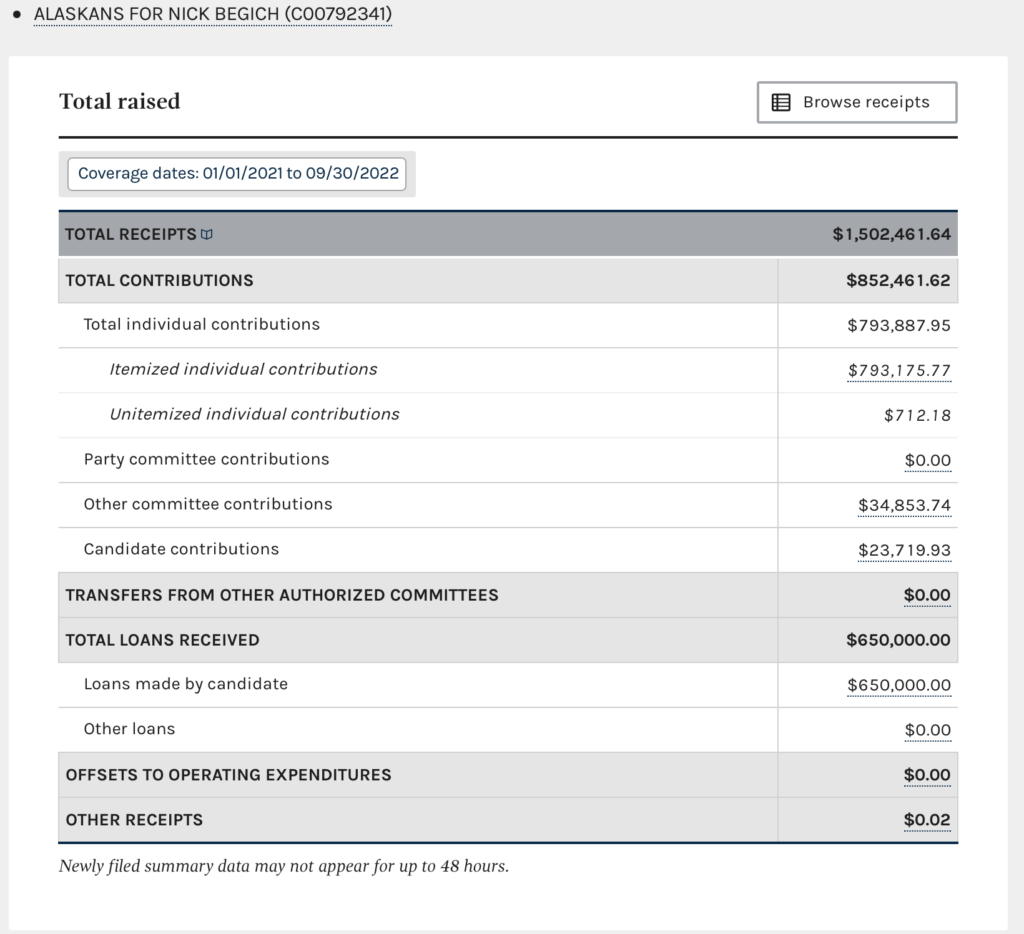
This only covers contributions through September 30, 2022. Begich has raised $1.5 million and only has $51,280 new contributions since the last report on September 5, 2022.Understanding FEC filings: The largest contribution to Begich’s campaign came from a loan to himself for $650,000. He also donated in-kind items like meals, lodging, and air travel for a total of $23,714.
Most of Begich’s individual contributions have been itemized and came through WinRed, an online fundraising platform for Republican candidates and conservative groups. Of Begich’s 1,105 donors, 977 have addresses in Alaska. His biggest donors are Daksha & Vinod Vakharia, from Casselberry, FL who gave $11,600, and business owner Jesse Sumner from Wasilla who gave $10,600.
Committee contributions come from groups, like PACs. Begich’s largest group donation was $10,000 from the National Automobile Dealers Association PAC. He also received $5,000 from the American Crystal Sugar Company Political Action Committee.
Independent Expenditures are things like ad buys or mailers sent out by organizations that are not associated with the campaigns, and are forbidden by law from working with campaigns. The only spending on Begich’s behalf was $845,338 from Americans for Prosperity Action, Inc.